Generic AI answers
Off-the-shelf chatbots answer from general knowledge. A RAG assistant answers from your documentation.
Services
AI Agent DevelopmentRAG Knowledge AssistantsAI Workflow Automationn8n Automation ServicesWhatsApp AI Chatbot & AutomationArabic AI Chatbot DevelopmentAI-Driven CRM AutomationAI Chatbots & Customer SupportAI Automation ConsultingMarkets
Dubai & the UAESaudi ArabiaBook a free auditWe build retrieval-augmented generation (RAG) systems on your documentation, policies, and product knowledge. The assistant retrieves the relevant passages first and answers from them, which keeps responses grounded in what your business has written down.
Custom scope after consultation
Scoped, built, and documented by our founder. You get a fixed scope and price before work starts.
A language model on its own does not know your pricing, policies, or product details. Retrieval-augmented generation fixes that by searching your documents first and answering from what it finds.
Axenor AI builds the whole pipeline: document ingestion, chunking, embeddings, vector search, answer generation, and an API your team or website can call. We also show you how the system is structured so you can maintain it.
Off-the-shelf chatbots answer from general knowledge. A RAG assistant answers from your documentation.
Staff lose time searching shared drives and old threads for answers that already exist in writing.
Different team members give different answers to the same question. One grounded source keeps replies consistent.
Every rag knowledge assistants project starts with the business outcome, then the workflow, content, tools, prompts, and handoff rules are designed around that goal.
We gather the source documents, remove duplicates and outdated content, and set up automated ingestion.
Documents are split into passages and stored as embeddings in a vector database for semantic search.
Each question retrieves the most relevant passages, and the model answers only from those passages.
We test against real questions, tune retrieval, and document the structure for your team.
Staff ask questions about processes, policies, and product details and get answers from company documentation.
Customers get accurate answers from your help content, with handoff to a person when needed.
Visitors ask about your services, projects, or documentation and get grounded answers in real time.
These pages help connect rag knowledge assistants with the wider automation system your business may need next.
Built by our founder. Client systems stay private, so these are the builds we can show in full.
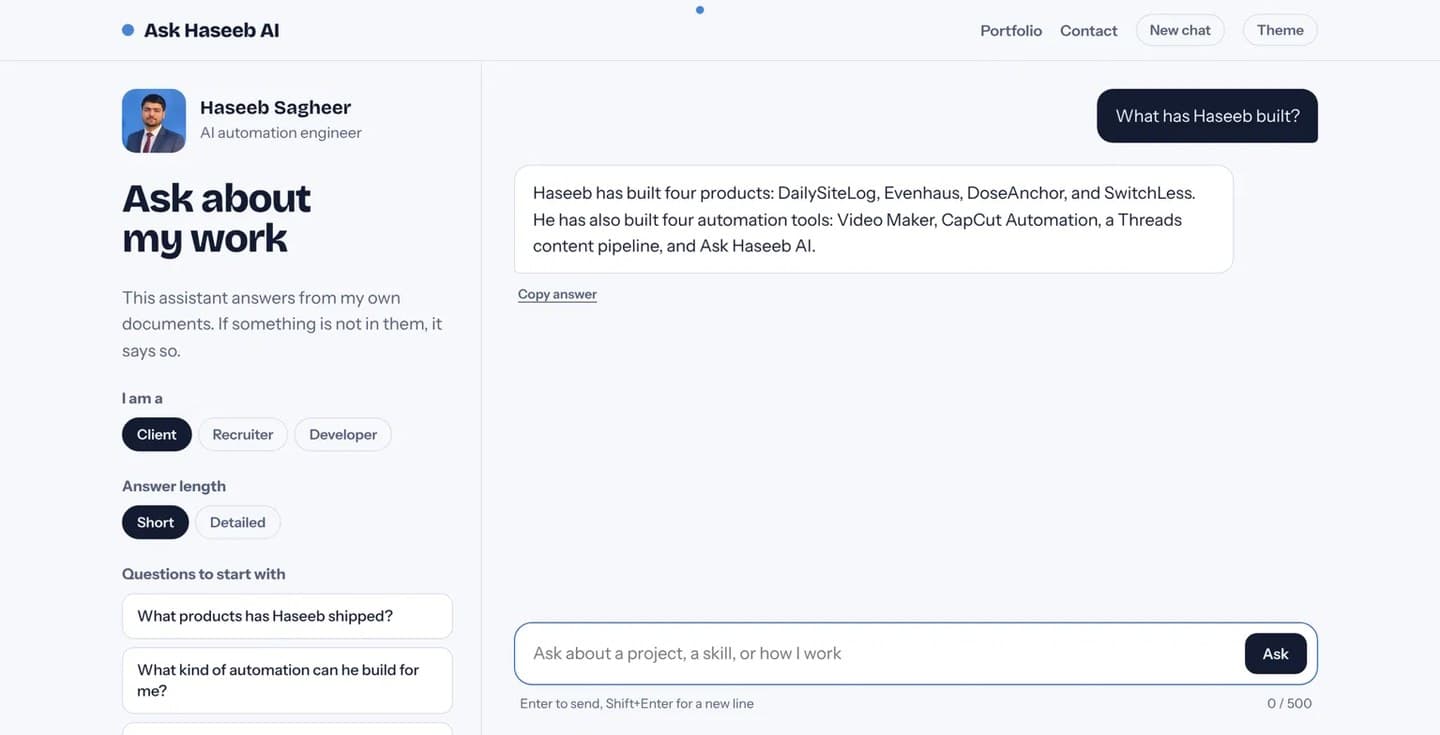
A live retrieval-augmented (RAG) assistant that answers questions about our founder's work from his own documents, and says so when the answer is not in them. New files are picked up from Google Drive, split into passages, embedded, and stored in a vector database; every answer is written from the passages it retrieves.
Built with Python, FastAPI, OpenAI, LangChain, Pinecone
Published word for word, with the platform and date.
“Haseeb built an internal AI assistant for our team using our own documentation. The main thing we wanted was reliable answers instead of the usual generic AI responses. The RAG setup is working well and he also showed us how the system was structured so we can maintain it later.”
“Haseeb did exactly what we needed. The project was an AI agent for handling customer enquiries and pulling information from our internal knowledge base. The first version needed some tweaking but he was patient with the feedback and improved the responses a lot. The workflow is now running properly.”
Direct answers about how this service works, what it includes, and how it is priced.
Ask it directly. You get an answer from the engineer who would build your system.