Leads wait while someone gets to them
Incoming leads sit in a form inbox until a person reads, qualifies, and enters them. An agent can qualify, validate, and push them into the CRM within seconds.
Services
AI Agent DevelopmentRAG Knowledge AssistantsAI Workflow Automationn8n Automation ServicesWhatsApp AI Chatbot & AutomationArabic AI Chatbot DevelopmentAI-Driven CRM AutomationAI Chatbots & Customer SupportAI Automation ConsultingMarkets
Dubai & the UAESaudi ArabiaBook a free auditWe design and build AI agents around one clearly defined job. Each agent gets the tools it needs through APIs, validation steps that check its output, fallback logic for when a step fails, and a human handoff for anything it should not decide alone.
Custom scope after consultation
Scoped, built, and documented by our founder. You get a fixed scope and price before work starts.
An AI agent is worth building when a task has several steps, touches more than one system, and follows rules a person can explain. Lead qualification, enquiry handling, data classification, and multi-step back-office work all fit that description.
Axenor AI builds each agent around one job. We define what a correct result looks like, connect the agent to the tools it needs, and add checks so a wrong answer is caught before it reaches your CRM, inbox, or customer.
Incoming leads sit in a form inbox until a person reads, qualifies, and enters them. An agent can qualify, validate, and push them into the CRM within seconds.
Someone reads incoming data, decides what it is, and forwards it to the right place. That decision loop can be automated with rules and review for edge cases.
Rigid if-this-then-that flows fail when input is messy. Agents with validation and fallback logic handle variation and escalate what they cannot resolve.
Every ai agent development project starts with the business outcome, then the workflow, content, tools, prompts, and handoff rules are designed around that goal.
We write down the task, the inputs, the allowed actions, and the cases that must go to a human.
The agent is connected to your CRM, email, forms, databases, or APIs with the minimum access it needs.
Output is checked against rules before it is used, and failed steps retry or escalate instead of failing silently.
We run the agent on real examples, fix what fails, document the workflow, and walk your team through it.
Read incoming enquiries, ask or infer the qualifying details, validate them, and write a clean record to the CRM.
Answer from an internal knowledge base, take simple actions, and pass complex cases to staff with context attached.
Check, classify, and route incoming data to the right destination, with exceptions flagged for review.
These pages help connect ai agent development with the wider automation system your business may need next.
Built by our founder. Client systems stay private, so these are the builds we can show in full.
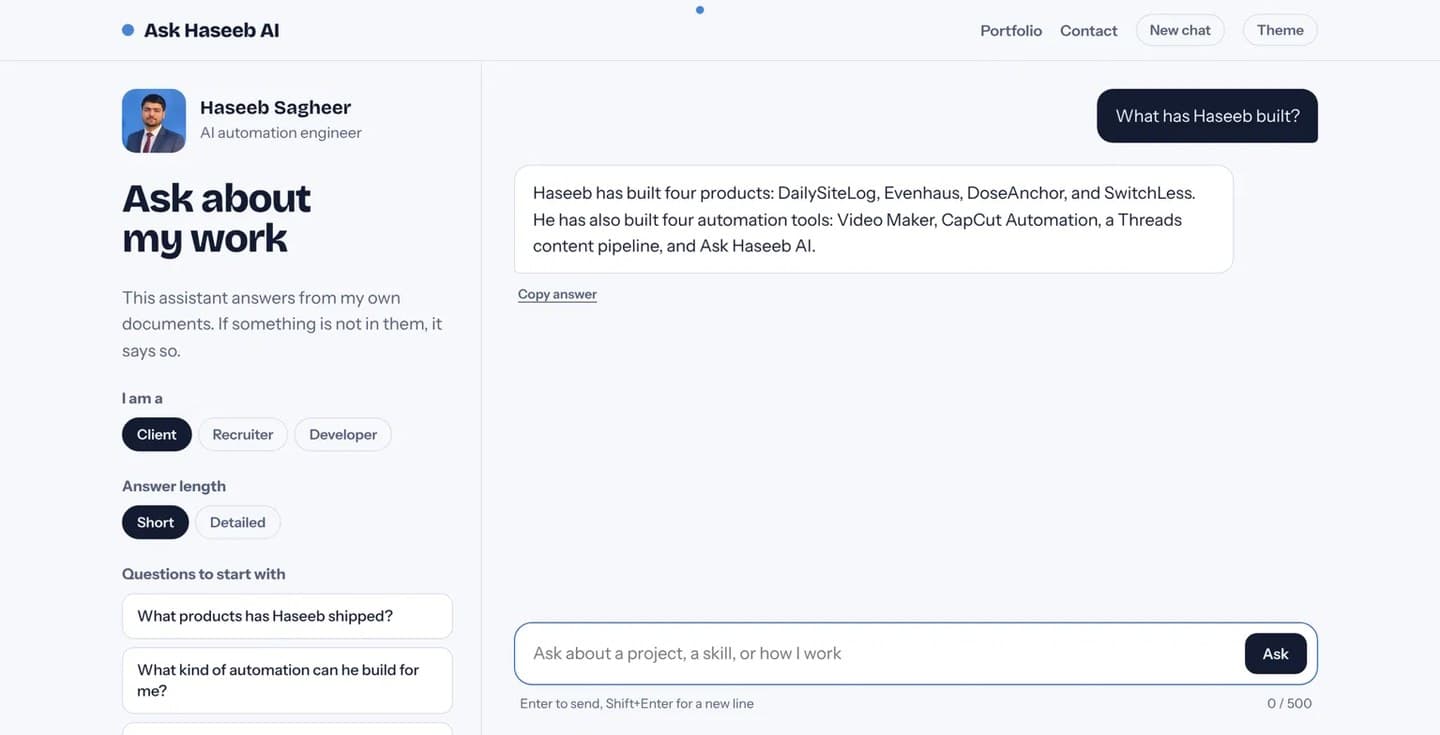
A live retrieval-augmented (RAG) assistant that answers questions about our founder's work from his own documents, and says so when the answer is not in them. New files are picked up from Google Drive, split into passages, embedded, and stored in a vector database; every answer is written from the passages it retrieves.
Built with Python, FastAPI, OpenAI, LangChain, Pinecone
A script goes in and a finished video comes out. The pipeline picks the images, animates the text, adds the sound, and places everything on the timeline without manual editing.
Published word for word, with the platform and date.
“Really solid work from Haseeb. We needed an AI agent that could handle incoming leads, qualify them and push the information into our CRM. He didn't just build the basic workflow, he also added the validation steps we were missing. Took a couple revisions but everything is working properly now.”
“Excellent technical work. We had a complicated workflow involving webhooks, APIs, Python and AI and needed someone who could understand the whole process rather than just one part of it. Haseeb built everything and also helped us clean up some of the logic in our existing automation. Very good communication and delivered what we agreed.”
“Very technical guy and easy to work with. We needed a multi-step agent workflow with API integrations, AI decision making and some fallback logic. Haseeb understood the requirements quickly and built the first version faster than I expected. We made a few changes afterwards and he handled those without any issues.”
Direct answers about how this service works, what it includes, and how it is priced.
Ask it directly. You get an answer from the engineer who would build your system.