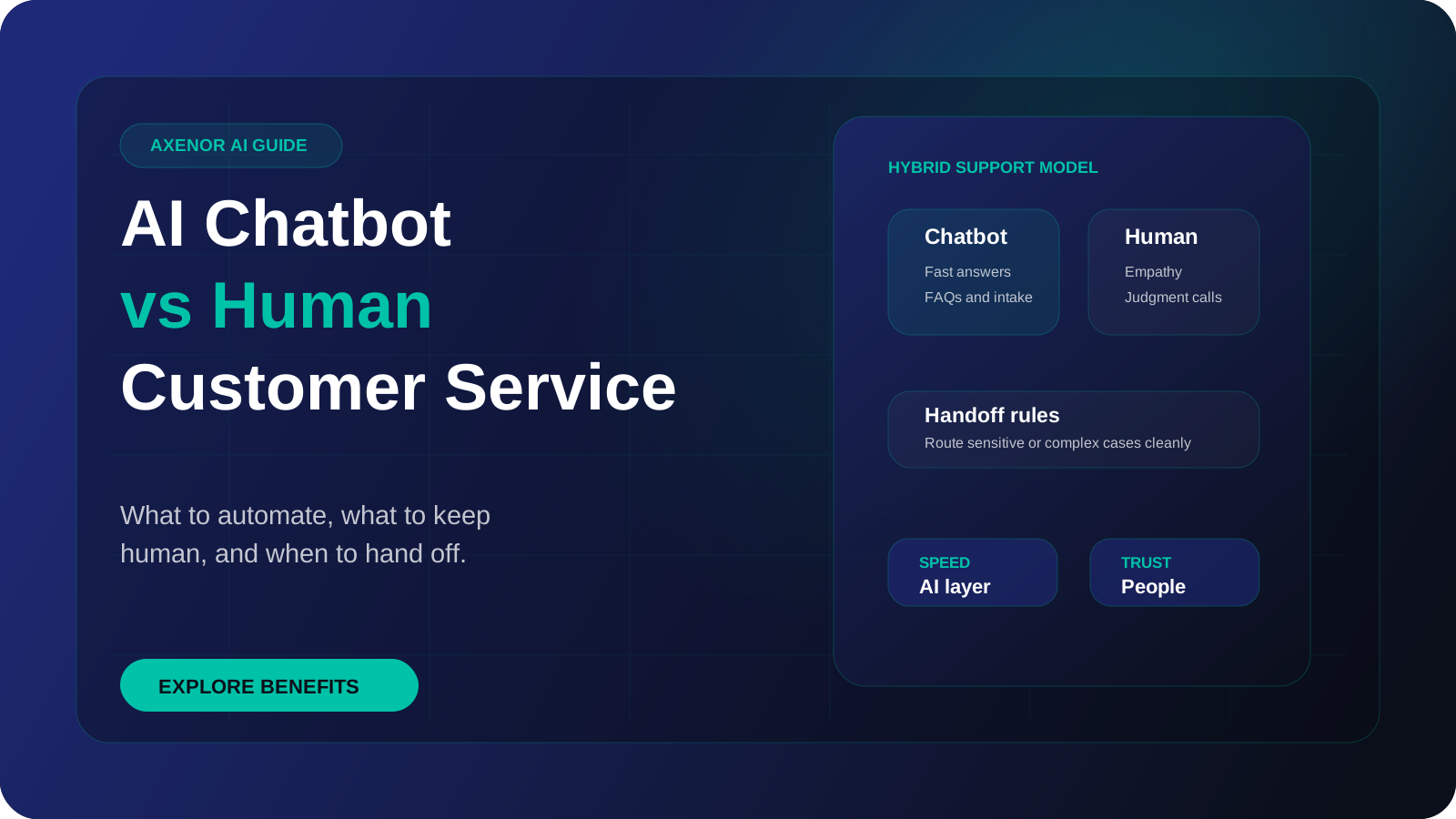
The chatbot vs live chat question has a short answer: use a bot for questions that have one known answer, and use a person for anything that needs judgement, account access or care. Most businesses end up with both, where the bot takes the first message and a human takes over when the conversation calls for it. The real work is deciding where that line sits and making the handoff clean.
This guide compares the two, shows which enquiries belong where, and explains what a good handoff contains.
What is the plain difference between a chatbot and live chat?
Live chat is a person typing replies through a chat window. The customer writes, an agent reads, and the agent answers. Quality depends on that agent and on whether anyone is at the desk.
An AI chatbot is software that reads the message and writes a reply itself. Older bots followed fixed menus and decision trees. Current ones use a language model and usually answer from your own documents, a method known as retrieval-augmented generation. Our guide on what a RAG chatbot is explains it without jargon.
Both can live in the same chat window. To the customer it is one conversation. Behind it, either software or a person is replying, and a well-built system can switch between them.
One related term causes confusion. An AI agent goes further than a chatbot: it can take actions such as updating a record or creating a ticket. The difference is covered in AI agent vs chatbot.
Chatbot vs live chat: how do they compare?
| Factor | AI chatbot | Live chat with a human |
|---|---|---|
| Speed of first reply | Immediate | Depends on queue and staffing |
| Availability | Any hour | Only when agents are on shift |
| Consistency | Same answer to the same question | Varies by agent and by day |
| Handling several chats at once | No practical limit | Each agent handles a few |
| Judgement and exceptions | Weak. Follows what it was given | Strong |
| Empathy with an upset customer | Limited, and can feel hollow | Real |
| Account-specific problems | Only if connected to your systems | Yes, with the right access |
| Unusual or new questions | May fail or need a handoff | Can work it out |
| Cost pattern | Setup cost, then usage that follows volume | Salaries that follow headcount and hours |
| Risk when it goes wrong | Confident wrong answer | Slow or inconsistent answer |
| What it needs to work | Accurate, current content | Training, tools and cover |
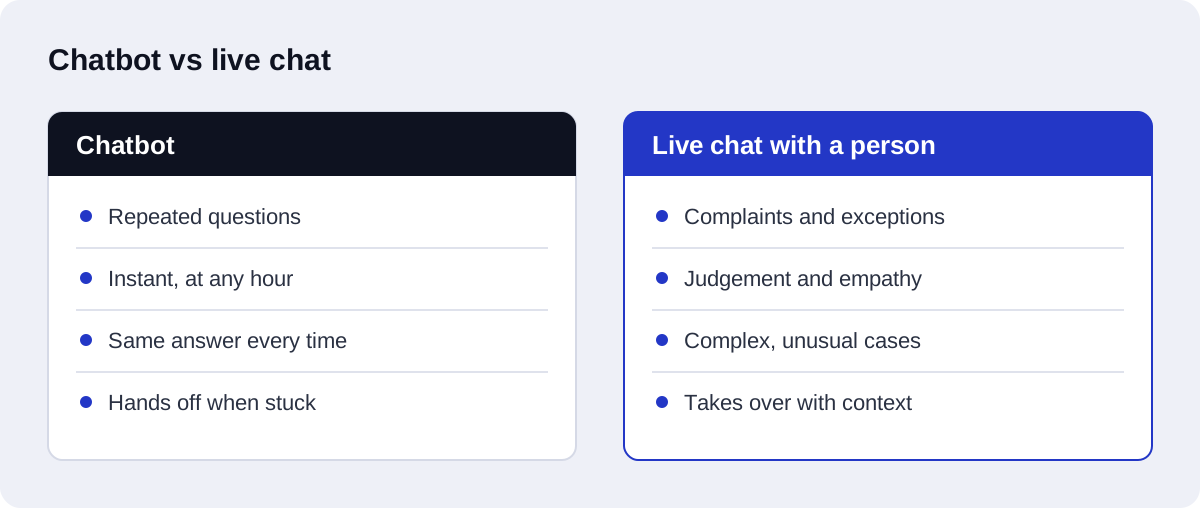
Neither column wins outright. The bot is better at being present and consistent. The person is better at thinking. The comparison of live chat vs chatbot only becomes useful once you look at what your customers actually ask.
Which enquiries suit a bot, and which suit a person?
Sort enquiries by type, not by channel or by customer.
| Enquiry type | Best handled by | Reason |
|---|---|---|
| Opening hours, location, delivery areas | Bot | Fixed facts |
| Pricing that is published | Bot | One correct answer |
| How a product or service works | Bot | Answered from your documents |
| Order or booking status | Bot, if connected to your system | A lookup, no judgement |
| Returns and refund policy as written | Bot | Policy text |
| Collecting details for a quote or callback | Bot | Structured questions |
| A refund outside the policy | Human | Needs discretion |
| A complaint | Human | Needs someone who can take responsibility |
| A billing dispute | Human | Needs account access and judgement |
| An upset or distressed customer | Human | Tone matters more than speed |
| A large or complex sale | Human, after the bot qualifies | Trust and negotiation |
| Anything legal, medical or safety related | Human | Wrong answers carry real harm |
| A question the bot has no content for | Human | Guessing is worse than waiting |
Two patterns stand out. Enquiries that are a lookup suit the bot. Enquiries that involve an exception, an emotion or a consequence suit a person.
Some sit in the middle. Order status is a bot task only if the bot can see your order system. Without that connection the bot can only say "someone will check", which is a handoff with extra steps.
What is the hybrid model?
The hybrid model puts the bot first and a person behind it. The bot answers what it can, collects details where a human is needed, and passes the conversation over. Staff see only the conversations that need them.
This is how most support setups we would recommend are arranged, because it lets each side do what it is good at. The customer with a simple question gets an answer in seconds at any hour. The customer with a real problem reaches a person who already knows the background.
The model has one weak point: the handoff. If it is bad, customers get the worst of both. They wait for a human anyway, and they have to explain everything twice.
What does a good handoff contain?
A handoff is a small package of information that lets a person pick up the conversation without asking the customer to start again. It should include:
- Who the customer is. Name and contact details, as far as they were given.
- What they want. One or two sentences in plain words.
- What has already been said. The full transcript, attached or linked.
- What the bot already answered. So the agent does not repeat it.
- Why it was handed over. For example: asked for a person, complaint detected, no matching content, or outside policy.
- Urgency. A flag if the message suggests something time-sensitive.
- Any reference numbers. Order, booking or account identifiers the customer supplied.
On the customer's side, a good handoff says three things clearly: that a person is taking over, roughly when to expect a reply, and that the details have been passed on so they will not need to repeat them. If no one is available until morning, the bot should say so. A false promise of "an agent will be with you shortly" at midnight does more damage than an honest "our team is back at nine".
The customer should also be able to ask for a person at any point and get one, without arguing with the bot first.
How do you decide by enquiry type?
Work from your own messages, not from general advice.
- Collect a sample. Pull recent chats, emails and messages from every channel.
- Group them. Write down the categories that appear: hours, pricing, order status, complaints and so on.
- Ask four questions of each group. Is there one correct answer? Is that answer written down somewhere? Does answering need access to a customer's account? What happens if the answer is wrong?
- Assign each group. One written answer, no account access and low harm if wrong goes to the bot. Anything needing judgement or carrying real consequences goes to a person. Account lookups go to the bot only if you are willing to connect it to your systems.
- Write the rules down. This list becomes the bot's instructions and the handoff triggers.
- Revisit it. After launch, the conversations the bot could not handle show you what to move or add.
If most of your volume lands in the "one written answer" group, a bot will take real work off your team. If most of it is exceptions and disputes, a bot will mostly collect details and route, which is still useful but a smaller gain.
How do staffing and hours affect the choice?
A few qualitative points are worth weighing.
Hours. Live chat only exists while someone is at the desk. If customers write in the evening, at weekends or from other time zones, a human-only setup leaves those messages unanswered until the next shift. A bot covers that gap, at least to answer simple questions and capture the rest.
Peaks. Human capacity is fixed in the short term. When volume jumps, queues grow. A bot does not queue, so it absorbs the simple part of a peak and leaves agents with the harder part.
Small teams. In a small business the person answering chat is often also doing three other jobs. Every repeated question interrupts something else. Taking those questions away matters more here than in a large support team.
Cover and turnover. When a single experienced agent is on leave or moves on, the knowledge goes with them. A bot's answers sit in documents that stay.
Cost shape. Human support cost rises with headcount and hours. Bot cost is mostly a setup fee plus usage, since AI models are billed per token. Neither is automatically cheaper. It depends on your volume and on how much of it is routine. For our own prices, see the cost of AI chatbots.
Channel rules. If you use WhatsApp, automated replies need the WhatsApp Business Platform, also called the Cloud API, not the free WhatsApp Business app. When a customer messages you, a 24-hour customer service window opens in which free-form replies are free, so a human who picks up the next morning is still inside it. Outside that window you need template messages, which Meta has charged for per message since 1 July 2025.
None of this removes the need for people. It changes what they spend their day on.
What mistakes do businesses make?
- Using a bot to hide from customers. If there is no route to a person, customers notice and resent it.
- Letting the bot guess. A bot with no content for a question should hand over, not improvise.
- Handing over without context. The customer repeats everything and the benefit is lost.
- Promising a human who is not there. Be honest about response times.
- Pretending the bot is a person. Say it is automated. People are more forgiving when they know.
- Treating launch as the end. Content goes out of date. Prices change, policies change, and the bot keeps quoting the old ones.
- Running live chat with no cover. A chat window that shows "online" while nobody is watching is worse than no chat at all.
- Sending everything to the bot to save money. Complaints and disputes handled badly cost more than the staff time saved.
What should you measure?
In the debate over AI vs human customer service, the numbers that settle it are your own. Track these by name:
- First response time, for bot and for human
- Resolution rate without handoff
- Handoff rate, split by reason
- Time to human reply after handoff
- Customer satisfaction, separately for bot-only and handed-over chats
- Repeat contact rate
- Unanswered question log
- Abandonment during handoff
Watch the handoff reasons most closely. A rising count of "no matching content" means the bot needs more material. A rising count of "customer asked for a person" on simple topics means its answers are not good enough.
How Axenor AI builds the handoff
Axenor AI is a founder-led studio. Every system is built by founder Haseeb Sagheer, a software engineer, working remotely with Python, FastAPI, the OpenAI API, LangChain, Pinecone and n8n. Focused builds usually take 3 to 10 days.
We treat the choice of chatbot vs human as a routing problem and build it in this order:
- Map the enquiries. We go through your real messages and agree which types the bot answers and which go to staff.
- Ground the bot in your content. Our AI chatbots for customer support answer from your documents. If your material is large or scattered, that is a RAG development job.
- Set the handoff triggers. A request for a person, a complaint, low confidence, or a topic on your "always human" list.
- Build the handoff package. A summary, the transcript, the reason and an urgency flag, sent to wherever your team already works: email, a shared inbox or WhatsApp.
- Connect systems where it pays. With AI-driven CRM automation, the handoff can create a ticket or update a contact record so nothing depends on someone copying and pasting.
- Test the edges. We write difficult messages on purpose and check that each one reaches a person.
- Review after launch. The unanswered question log drives the first round of updates.
If you are weighing up whether a bot is worth it at all, read the benefits of AI chatbots for customer support, which sets out when each benefit appears and when it does not. You can also look at client reviews and our work.
To find out where the line should sit in your business, book a free automation audit and bring a sample of your recent customer messages.